
Netanyahu Claims Israel-US Have Almost Full Control Over Iran Skies, Says They Changed The Face Of Middle East
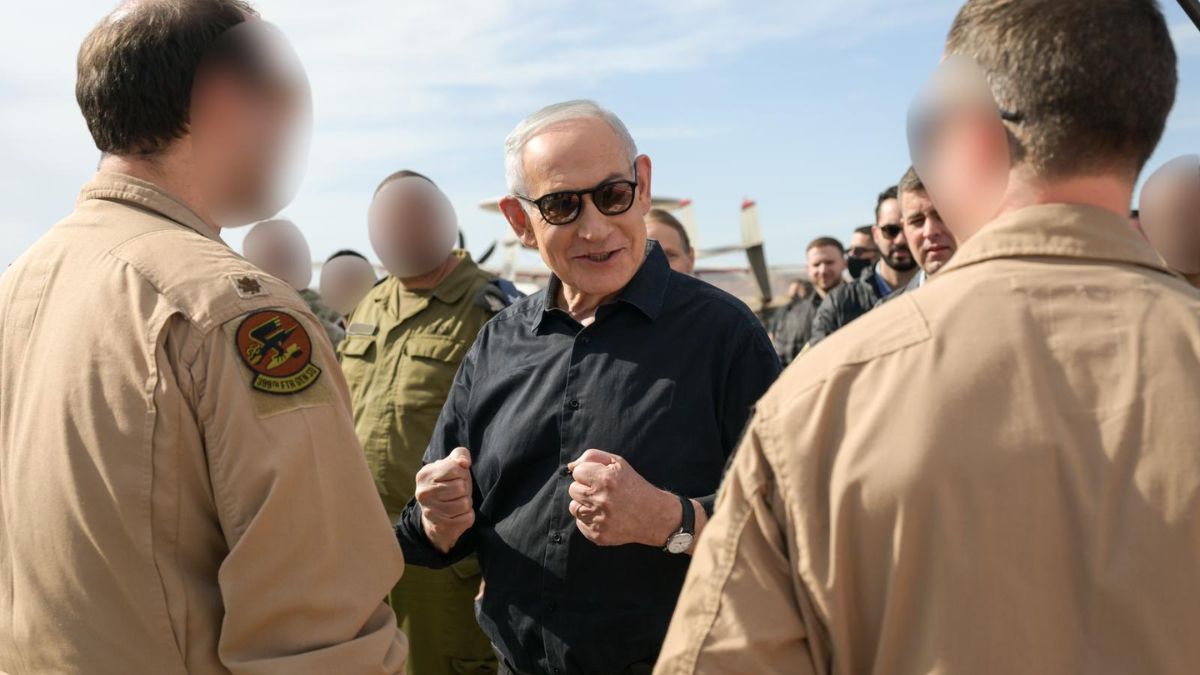
Israeli PM Benjamin Netanyahu, in a recent address, said, "Together, we have changed the face of the Middle East." Image courtesy: X.com/@netanyahu

Israeli Prime Minister Benjamin Netanyahu has said that Israel and the United States have achieved “almost complete control” of Iranian airspace, following a series of coordinated military strikes carried out under a joint campaign. In a video statement, Netanyahu said the military operations had given the two allies dominance over the skies above Tehran.
“We achieved almost complete control over the skies of Tehran,” Netanyahu said, marking a major escalation in the ongoing confrontation between Israel and Iran. He described the development as a strategic turning point in the conflict.
According to the Israeli leader, the operations were conducted in coordination with Washington and with the full backing of US President Donald Trump.
Operation Rising Lion and expanding military campaign
Netanyahu said the strikes were part of a joint effort dubbed ‘Operation Rising Lion’, which he described as aimed at eliminating what Israel sees as an immediate threat from Iran. The Israeli PM claimed that the operation targeted Iran’s ballistic missile infrastructure and military capabilities, significantly reducing risks to Israel.
Highlighting what he described as the achievements of the campaign’s first phase, Netanyahu said, “In the first week, we eliminated the dictator Khamenei and destroyed hundreds of ballistic missile launchers.” He further argued that these actions had dramatically altered the balance of power in the region, strengthening Israel’s position.
Conflict linked to Israel’s post-October 7 strategy
Netanyahu framed the current military campaign as part of a broader strategy that Israel adopted following the Hamas-led attacks of October 7, 2023. He said those attacks prompted his government to pursue a more aggressive regional security doctrine.
“As I promised you two days after October 7, we are changing the face of the Middle East,” Netanyahu said, adding, “We have turned Israel into a regional power. All of this requires courage, initiative and taking risks.”
The Israeli leader added that his government had undertaken “proactive and surprising actions” to shift the regional balance of power.
Israel warns of Iranian nuclear and missile threat
Netanyahu reiterated Israel’s long-standing position that Iran’s nuclear ambitions and missile capabilities pose a major threat. “We are facing an extremely evil regime that is plotting to destroy us with atomic bombs and tens of thousands of missiles,” he said.
He also alleged that Iran’s leadership had attempted to move critical military assets underground in fortified locations to protect them from potential strikes.
“Khamenei ordered the capabilities to be restored and buried underground so that they would be immune,” Netanyahu claimed. According to him, the joint military action by Israel and the US was timed to prevent these capabilities from becoming operational.
Warning to Hezbollah and regional actors
Netanyahu also issued a warning to Lebanon and the Hezbollah militant group, urging the Lebanese government to enforce the existing ceasefire agreement and disarm the Iran-backed organisation. “I repeat to the Lebanese government: your responsibility is to enforce the ceasefire agreement and disarm Hezbollah,” he said.
He cautioned that failure to do so could have “disastrous consequences for Lebanon.”
The Israeli leader also warned members of Iran’s Islamic Revolutionary Guard Corps (IRGC) that they remain potential targets. “To the Revolutionary Guards operatives — you too are in our crosshairs,” he said.
Appeal to Iranian people and vision for future relations
In a direct appeal to citizens inside Iran, Netanyahu said Israel’s conflict was with the Iranian leadership rather than the Iranian people. “To the Iranian people — we seek to liberate Iran,” he said. However, Netanyahu emphasised that any political change would ultimately depend on Iranians themselves.
“At the end of the day, liberation from the yoke of tyranny will depend on you, the Iranian people.” Netanyahu also suggested that relations between the two countries could improve in the future. “I believe that if you stand up at the moment of truth, the day will not be far off when Israel and Iran return to being brave friends,” he said.
Moreover, Netanyahu argued that many countries in the region increasingly view Israel as a strategic partner, particularly in the context of concerns over Iran’s regional activities. “Iran attacked 12 countries around it. We stand by them, and they see our great military and technological capabilities,” he said.
He predicted that the campaign against Iran could ultimately lead to expanded diplomatic cooperation and new regional partnerships.