Putin Warned Bush Pakistan Was a ‘Junta With Nuclear Weapons’, Newly Released Transcripts Reveal
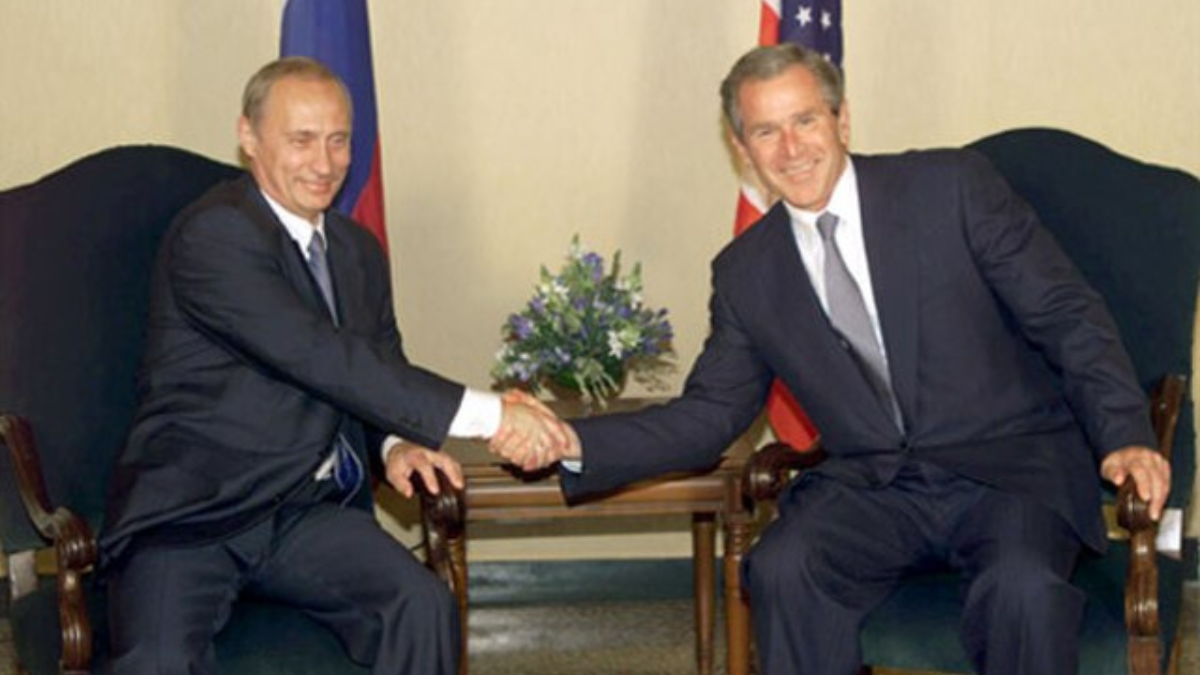
Russian President Putin with US President George W. Bush in 2001

Russian President Vladimir Putin privately warned US President George W. Bush more than two decades ago that Pakistan posed a serious nuclear proliferation risk, describing its military-led system as “a junta with nuclear weapons”, according to newly declassified transcripts released by the National Security Archive. The documents reveal that despite Pakistan’s status as a key US ally at the time, both Washington and Moscow harboured deep concerns about Islamabad’s control over its atomic arsenal and the risk of illicit nuclear transfers.
The warnings emerged during Putin and Bush’s first face-to-face meeting on June 16, 2001, in Slovenia, months before the September 11 attacks reshaped global geopolitics. In unusually candid exchanges, Putin questioned why Pakistan did not face the same sustained international pressure as other countries accused of nuclear violations, arguing that Western governments were overly tolerant of Islamabad despite its lack of democratic accountability and its troubled proliferation record.
What did Putin say about Pakistan to Bush?
“It is just a junta with nuclear weapons. It is no democracy, yet the West does not criticise it,” Putin told Bush, according to the transcript. The remark underscored Moscow’s scepticism over how Pakistan, then ruled by General Pervez Musharraf following a military coup, was treated differently from countries such as Iran and North Korea.
Bush did not dispute Putin’s assessment. Instead, the records show that the US president acknowledged Pakistan remained a serious non-proliferation concern, even as Washington relied heavily on Islamabad for cooperation in the region. The discussions suggest that behind closed doors, Pakistan’s nuclear stewardship was viewed with suspicion at the highest levels of both governments.
How did concerns over Pakistan nukes resurfaced at other Putin-Bush meetings?
The issue resurfaced repeatedly in subsequent meetings. During an Oval Office conversation on September 29, 2005, Putin told Bush that uranium found in Iranian centrifuges was of Pakistani origin, reinforcing long-standing allegations that Pakistan’s nuclear establishment had been linked to clandestine proliferation networks. Bush immediately agreed the discovery was alarming, calling it a violation that made the United States “nervous”.
“It makes us nervous, too,” Bush said, as the two leaders discussed the danger of sensitive nuclear material spreading beyond state control. Putin responded pointedly, “Think about us,” highlighting Russia’s concern that such leaks could directly threaten its own security.
How did Bush raise the nuke proliferation concerns with Musharraf?
Bush told Putin he had personally raised the issue with Musharraf following the exposure of Abdul Qadeer Khan’s network, which had supplied nuclear technology to Iran, North Korea and Libya. While Bush noted that Khan and several associates had been jailed or placed under house arrest, he admitted Washington still lacked clarity on the full scope of what had been transferred and to whom.
“We want to know what they said,” Bush remarked, reflecting frustration over what US officials saw as incomplete disclosures by Pakistani authorities. Putin added that Russian experts believed there had been continued interaction involving Iran’s enrichment programme, a concern Bush said was echoed by US intelligence assessments.
How is Pakistan nukes proliferation as global threat?
The transcripts show that Pakistan’s nuclear programme was not viewed as an isolated issue but as part of a broader pattern of instability, weak oversight and opaque decision-making. The National Security Archive said the records offer “previously unavailable evidence” of the depth of private concern shared by US and Russian leaders, in stark contrast to the far more restrained public rhetoric of the time.
Pakistan developed its nuclear weapons outside the Nuclear Non-Proliferation Treaty and has remained under international scrutiny since the early 2000s, when the AQ Khan network’s global reach was first exposed.