Russia, China Oppose US Presidency of Powerful UNSC over Iran War
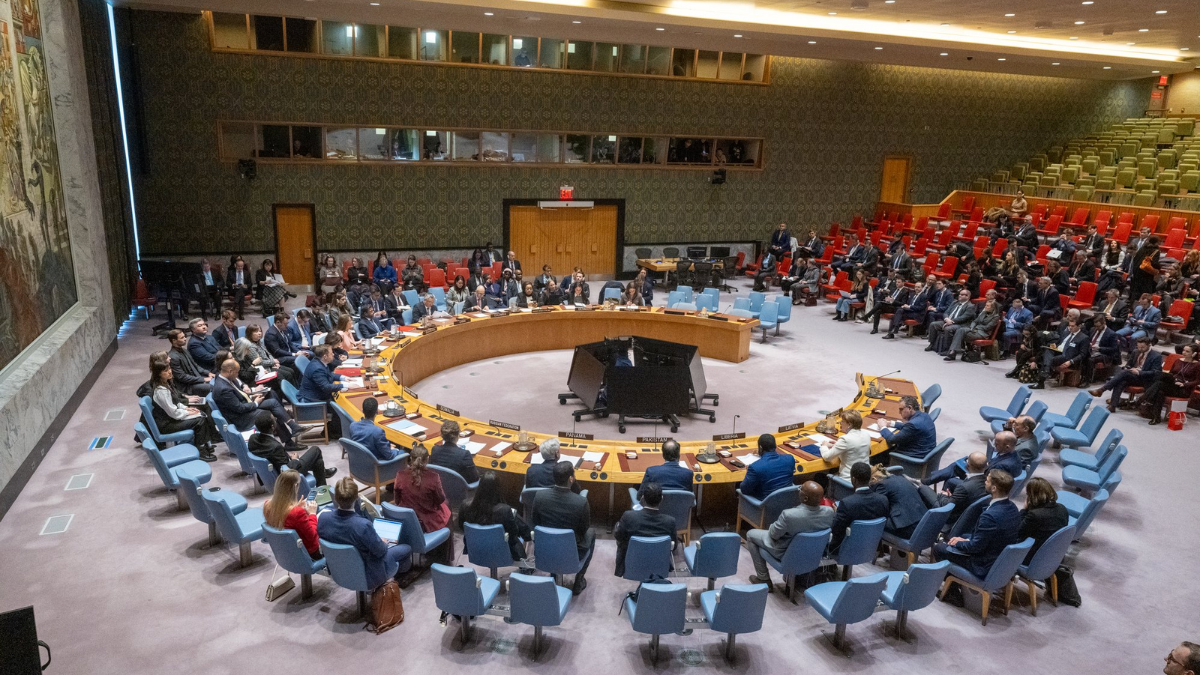
Russia, China Block US UNSC Agenda. Image Courtesy: X/ @UN

The geopolitical polarisation over the US-Israel war on Iran spilled over into the United Nations Security Council (UNSC), as Russia and China opposed the American presidency of the powerful global body over its current military conflict with Tehran.
The 15-member body’s monthly programme of work failed during its meeting, as Washington, a veto-wielding permanent member, assumed the UNSC presidency for March 2026.
The monthly programme of work outlines the UNSC’s anticipated meetings, events, and agenda for a particular month and is adopted by the body’s first meeting at the commencement of a new presidency.
This time, the US-drafted UNSC programme of work for March 2026 under its presidency could not be adopted on Monday (March 2, 2026) after other veto-wielding permanent members, Russia and China, objected to the 1737 Sanctions Committee agenda regarding Iran.
“Russia & China objected to the adoption of the US-drafted UNSC PoW (Programme of Work) for March,” Russia’s Permanent Mission to the UN said.
“We were compelled to take this step because the provisional programme of work proposed by the US included a briefing on the work of the 1737 Sanctions Committee concerning Iran, whose work was allegedly resumed in September 2025 following the triggering by the UK, France, and Germany of the “snapback” mechanism to reimpose the anti-Iranian Security Council resolutions,” Russia said.
“In February, we once again brought our position on this matter to the attention of our US colleagues, urging them to refrain from including such an event in the provisional programme of work. Unfortunately, our appeal remained unheeded. For this very reason, we had no other choice but to object to the adoption of the UNSC programme of work for March,” it said.
In 2015, the UNSC adopted a resolution that implemented the Joint Comprehensive Plan of Action (JCPOA) concerning Iran’s nuclear programme. In August 2020, the United States invoked the resolution’s “snapback” mechanism, under which the Security Council can reimpose UN sanctions.
Last year, France, Germany, and the United Kingdom (UK) (collectively known as the “E3”) invoked the snapback mechanism, which resulted in the sanctions being reimposed on Iran on September 27, 2025, based on Iran’s continuing “significant non-performance” of its nuclear commitments.
After the UNSC meeting could not approve the monthly programme of work, the US released its agenda on its own. The US Ambassador to the UN Mike Waltz’s scheduled press conference for Tuesday (March 3) was also cancelled.
Meanwhile, on Wednesday (March 4), Israel launched a new wave of military strikes on Iran, while the US said it hit nearly 2,000 targets since Saturday (February 28). Israel’s fresh attacks came after Iran fired three separate missile barrages on its territory overnight, in which an Israeli woman suffered minor injuries.
Israel’s military described its Wednesday (March 4) response as a “broad wave of strikes” targeting missile infrastructure and military facilities. United States Central Command commander Admiral Brad Cooper said the American forces were targeting ballistic missiles and “all the things that can shoot at us.”
“These forces bring a massive amount of firepower, representing the largest buildup by the US in the Middle East in a generation,” Cooper said, describing the opening barrage as exceeding the scale of the 2003 “shock and awe” campaign against Saddam Husseinʼs Iraq. “We’ve just begun,” he added.