Sanctions Unlawful, Punitive Under International Law: UN Rights Experts Slam US Naval Blockade On Venezuela
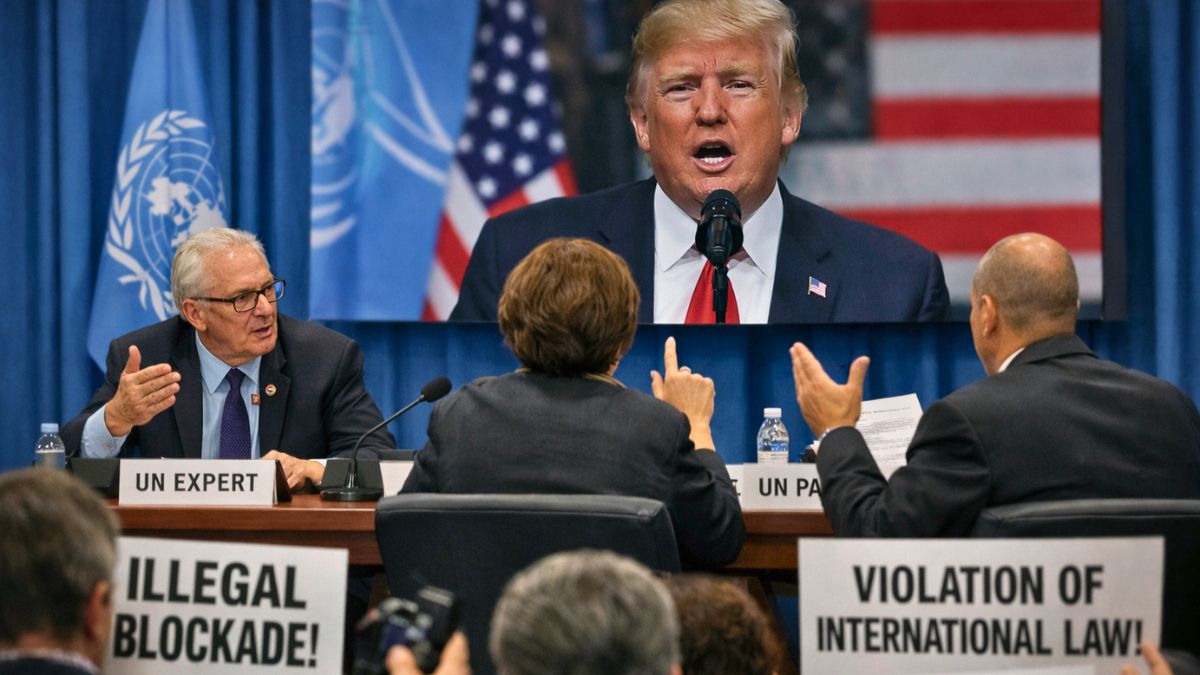
“There are serious concerns that the sanctions are unlawful, disproportionate and punitive under international law,” the experts said. Image courtesy: AI-generated picture via Sora

Just a few days back, US President Donald Trump announced a “complete blockade of all sanctioned oil tankers going into and out of Venezuela,” thereby increasing the pressure on Nicolás Maduro’s regime as 15,000 US troops and 11 warships stand ready in nearby waters. The move is now facing criticism.
Four United Nations human rights experts have strongly criticised the United States’ partial naval blockade of Venezuela, describing it as an illegal act of armed aggression and urging the US Congress to intervene to halt the operation. Worth noting here is that under international law, a naval blockade is considered an act of war.
In a joint statement issued on Wednesday (December 24, 2025), the experts said there is “no right to enforce unilateral sanctions through an armed blockade”, warning that the move violates international law and dangerously escalates tensions in the Caribbean.
Experts say US blockade violates UN Charter
The experts – Ben Saul, special rapporteur on protecting human rights while countering terrorism; George Katrougalos, an expert on promoting a democratic and equitable international order; development expert Surya Deva; and Gina Romero, special rapporteur on the right to freedom of peaceful assembly and association – stressed that a naval blockade constitutes a prohibited use of military force under the UN Charter, regardless of whether it is partial or limited in scope.
“It is such a serious use of force that it is also expressly recognised as illegal armed aggression under the General Assembly’s 1974 Definition of Aggression,” the statement said. They warned that the use and threat of force at sea and on land could severely undermine the right to life and other fundamental human rights in Venezuela.
Trump administration tightens pressure on Caracas
The criticism comes in the wake of US President Trump’s announcement of a naval blockade against Venezuela, part of a broader strategy to intensify pressure on the government of President Maduro. Washington has deployed significant US naval and air assets in the Caribbean, intercepting oil tankers and vessels it claims are operating under sanctions linked to Venezuela’s energy trade.
Trump has accused Caracas of using oil revenues, which are Venezuela’s primary source of income, to finance “narcoterrorism, human trafficking, murders and kidnappings.”
Venezuela rejects accusations, alleges regime-change plot
Caracas has categorically denied any involvement in drug trafficking, countering that the US actions are aimed at toppling the Maduro government and gaining control over the country’s vast oil reserves, the largest proven reserves in the world. Venezuela has repeatedly described the blockade and sanctions regime as a form of economic warfare.
According to the UN experts, US forces have conducted dozens of air strikes since September on boats Washington alleges were transporting drugs. However, the US has not publicly presented evidence to support these claims. More than 100 people have reportedly been killed in these operations.
“These killings amount to violations of the right to life,” the experts said, calling for independent investigations and accountability for those responsible.
Call for congressional and international action
The UN experts urged the US Congress to step in to prevent further attacks and lift the blockade, warning that continued military action risks destabilising the region. They stated that Trump’s blockade follows the US’ designation in November 2025 of elements of the Venezuelan Government, including its President, as part of an alleged “foreign terrorist organisation” known as Cartel de los Soles.
“Such cartel does not appear to exist. The US has also claimed that Venezuela has “stolen” US property and must return it,” saying so, they called on other countries to take measures to stop the blockade, prevent further loss of life and ensure that those responsible for illegal actions are brought to justice.