Under India’s BRICS Presidency, Can The G7 Divide Be Bridged And De-Dollarisation Debate Quelled?
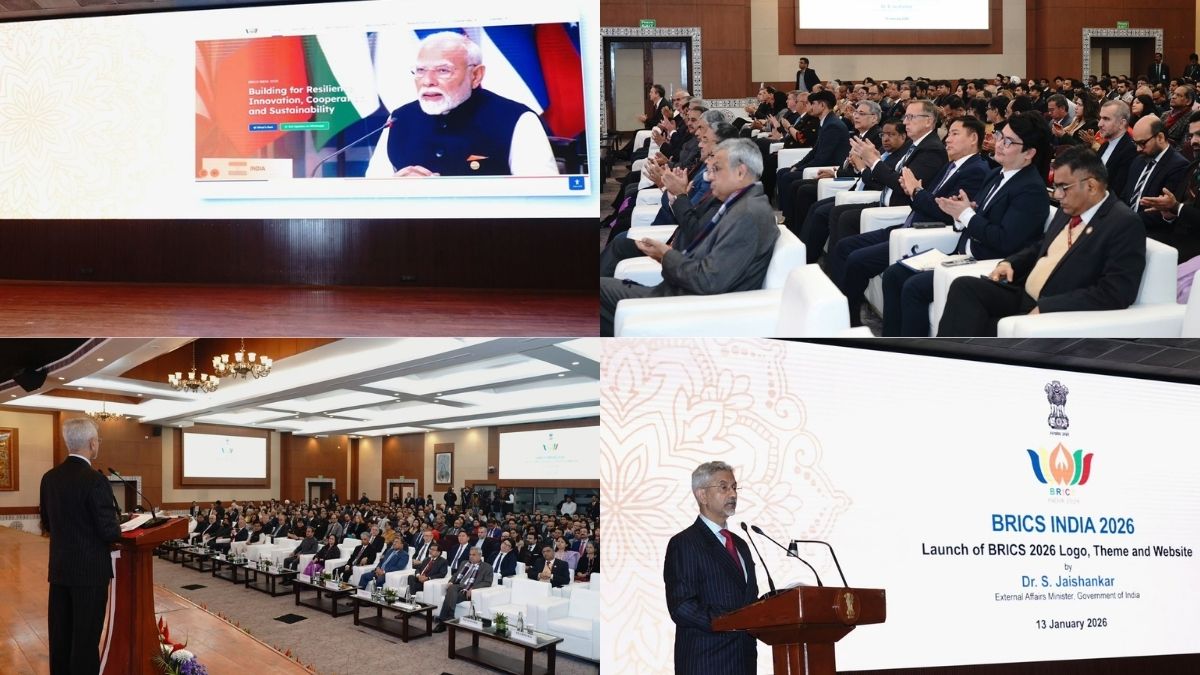
With India set to take over the BRICS presidency in 2026 New Delhi positions itself as a bridge between rival global blocs while seeking cooperation over confrontation in a divided world. Image courtesy: X.com/@DrSJaishankar

India is readying itself to take over the BRICS presidency in 2026, as it positions itself as a rare geopolitical bridge, as global economic blocs harden rivalry.
The opportunity for India’s BRICS leadership is immense, like the one provided by the G20 presidency in 2023, when it successfully brought all members together for a joint statement, overcoming their differences.
France, a trusted and dependable strategic partner, has put its weight behind India to achieve the impossible: Bridging the G7-BRICS divide over the US versus Russia, versus China geopolitics.
What is India’s agenda for the BRICS Presidency in 2026?
At the launch of India’s BRICS Presidency logo on Tuesday (January 13, 2026), External Affairs Minister Dr. S. Jaishankar emphasised the “greater global welfare” that would drive the people-centric, humanity-first approach of Prime Minister Narendra Modi.
The message was not lost on anyone: BRICS, which began as a five-member global platform, has expanded, its influence and reach have widened, and it has evolved into a powerful voice representing major non-Western economies.
The Indian BRICS presidency comes at a time when the global world order is in a state of flux, with geopolitical uncertainties, economic volatility, climate risks, and technological disruption being the order of the day.
What did Jaishankar say India would do during the BRICS presidency?
Jaishankar was clear: India does not see BRICS as a disruptive counterweight to existing global institutions. It would rather be a complementary forum that reflects shifting realities.
The theme, unveiled for BRICS 2026, was ‘Building for Resilience, Innovation, Cooperation and Sustainability’. The message is all about continuity with India’s broader strategic posture of inclusive development, pragmatic multilateralism, and dialogue instead of division.
The BRICS logo for 2026 is a blend of tradition and modernity, encompassing all colours representing its members. The symbolism was unity without erasing diversity in the BRICS composition, a subtle but deliberate geopolitical statement.
How did France stand with India on the BRICS presidency?
France, as articulated by President Emmanuel Macron on January 9, wanted restraint, with G7 shedding its anti-China, anti-Russia, and anti-BRICS signalling, just as BRICS must avoid the perceptions of being opposed to the US or G7.
Macron publicly argued that avoiding bloc geopolitics was good for global stability and security. Paris stressed that the G7 and BRICS must work together rather than being on opposing sides.
France backed India’s BRICS presidency, vociferously expressing that this provided a practical opportunity for the G7 and BRICS to mend fences.
India’s image as a trusted partner and one of the global pillars in multilateral forums such as the G20 and BRICS, its presidency of the BRICS placed it at an enviable position as the pole star to aid the world and regional platforms to navigate closer to cooperation.
Can the De-Dollarisation debate end under Indian BRICS presidency?
India’s most profound impression on the new, emerging world order could be its ability to bring the global powers together to find an answer to the de-dollarisation question.
De-dollarisation is being touted as the biggest challenge posed by BRICS to the US’s global financial dominance. But the reality of the global trading currency debate could be more nuanced than what the current perception is.
BRICS, in its engagements in the previous years, has discussed the possibility of trading in local currencies, which could expand its financial cooperation, as well as bring down the dependence and vulnerabilities associated with the US Dollar shocks.
Yet, there is no imminent outcome on de-dollarisation from these discussions within BRICS. But, just the talks on de-dollarisation reflect hedging by BRICS nations against unilateral US sanctions and currency volatility, apart from the asymmetric American financial power. The idea, though, has not yet taken the form of an ideological crusade within BRICS.
What has been India’s position on De-Dollarisation?
India has always been doing a balancing act on the question of de-dollarisation, all because of its over-cautious approach not to derail the global trade. Yet, it fully supports greater financial resilience and diversified payment mechanisms, which it has worked out with some partners bilaterally.
Notwithstanding these positions, India has remained deeply enmeshed within the dollar-based global trading and financial systems.
As the BRICS president, India could offer a framework under which de-dollarisation could be an option, providing for a gradual and market-driven approach instead of a confrontation with the US, which has been its long-standing argument, aligning with France’s articulation of preventing economic fragmentation of the world.
The big question is, can India, as the head of BRICS in its 20th year, help bridge the divide with the G7, quell the de-dollarisation debate, and foster a cooperative economic framework for the world, devoid of bloc geopolitics?