India-US Sign Rs 7,995 Crore Sustainment Deal For Navy’s MH-60R Seahawk All-Weather Capable Helicopters
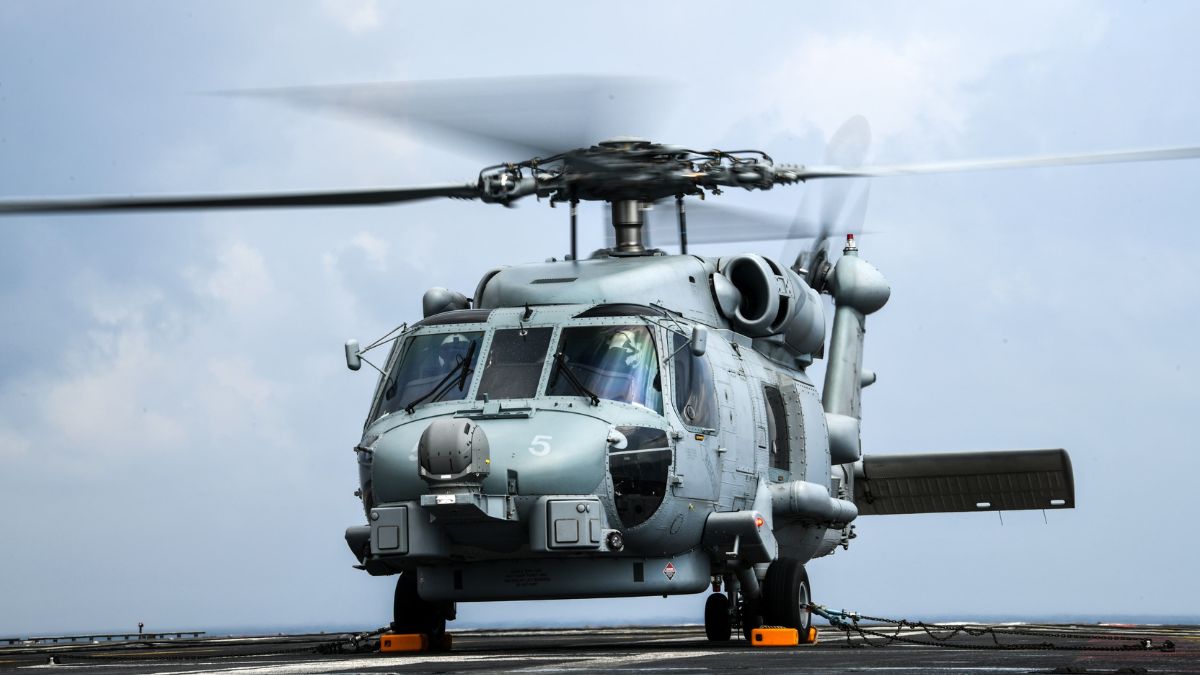
The sustainment support would significantly enhance the operational availability and maintainability of the helicopters. Image courtesy: PIB

In order to provide sustainment support of Indian Navy’s fleet of MH60R Seahawk multirole helicopters, the Ministry of Defence on Friday (November 28, 2025) signed Letters of Offer and Acceptance (LOAs) with the United States for a long-term agreement, valued at nearly Rs 8,000 crore.
India-US’ sustainment agreement for the naval helicopters covers a comprehensive five-year sustainment package designed to keep the fleet mission-ready across India’s expansive maritime zones. Indian Navy’s MH-60R Seahawk multirole helicopters are a critical asset for anti-submarine and maritime warfare.
Valued at approximately ₹7,995 crore, the ministry said the LOAs were signed under the US Government’s Foreign Military Sales (FMS) programme, in the presence of Defence Secretary Rajesh Kumar Singh in New Delhi.
MH-60R helicopters sustainment deal: What does the package include?
The sustainment support is a multi-layered logistics and maintenance ecosystem that covers provisioning of spares and support equipment, product support and technical training, repair and replenishment of components, along with establishment of intermediate-level component repair facilities in India, and periodic maintenance inspection infrastructure.
This all-encompassing package ensures the MH-60R fleet remains fully functional, safe, and deployable across all mission profiles, especially in high-tempo maritime environments.
“The sustainment support would significantly enhance the operational availability and maintainability of the technologically advanced, all-weather capable MH60R helicopters, which also have Anti-Submarine Warfare capability. In addition, the support would enable the operation of these helicopters from dispersed locations as well as ships,” the minister shared.
How will this boost Aatmanirbhar Bharat and domestic defence capability?
A major highlight of the agreement is the plan to indigenously develop maintenance and repair facilities for the MH-60R fleet. According to the Defence Ministry, this initiative supports the government’s Aatmanirbhar Bharat vision by reducing long-term dependence on US support, enabling Indian MSMEs and defence firms to participate in supply and service chains.
This would also enhance local capabilities for high-end rotary-wing maintenance. By building these capacities domestically, India moves closer to establishing a self-reliant, sustainable aviation support ecosystem for its modern naval platforms.
Why Are MH-60R helicopters vital for India’s maritime security?
The MH-60R Seahawk, acquired under a major India–US defence deal, is a potent naval asset equipped for Anti-Submarine Warfare (ASW), surface warfare, search and rescue, reconnaissance, anti-ship missions, and special operations support. With all-weather capability and advanced sensors, these helicopters significantly enhance India’s maritime surveillance and warfighting effectiveness.
The helicopters are a part of the 24-aircraft FMS contract signed with the US government in Feb 2020. MH 60R helicopter have enhanced India’s blue-water capabilities, extending the operational reach of the Navy and supporting sustained naval operations across spectrums and over vast maritime domains.
India’s new sustainment deal with the US will ensure the helicopters can operate seamlessly from dispersed coastal bases and frontline warships, maintaining optimal performance across primary and secondary roles.
What impact will this have on operational readiness?
According to the Defence Ministry, the deal will substantially increase the operational availability of the MH-60R fleet, an essential requirement as India faces growing challenges in the Indian Ocean Region.
By expanding maintenance infrastructure within India, the Navy will gain faster turnaround times, higher mission reliability, and greater flexibility in deploying assets across theatre commands.
Meanwhile, Defence Secretary Rajesh Kumar Singh earlier today reitirated armed forces’ increased push on ‘Aatmanirbharta’ (self-reliance), saying the government is looking to source a majority of its defence equipment indigenously within the next decade. Addressing ANI’s National Security Summit here, he expressed hope that majority of our equipment will be Indian in the next 10 years or so.
“Over a period of time you are going to see a decreasing dependence, it will never go away altogether where we have gaps like jet engines. There will be areas where it is infeasible to try to be self-sufficient. You will have to rely on some supply chains outside, hopefully in trusted geographies and not that are adversarial to us,” he stressed.