Indian Navy Chief Says ₹1.27 Lakh-Crore Naval Modernisation Plan Approved, Releases New Maritime Doctrine
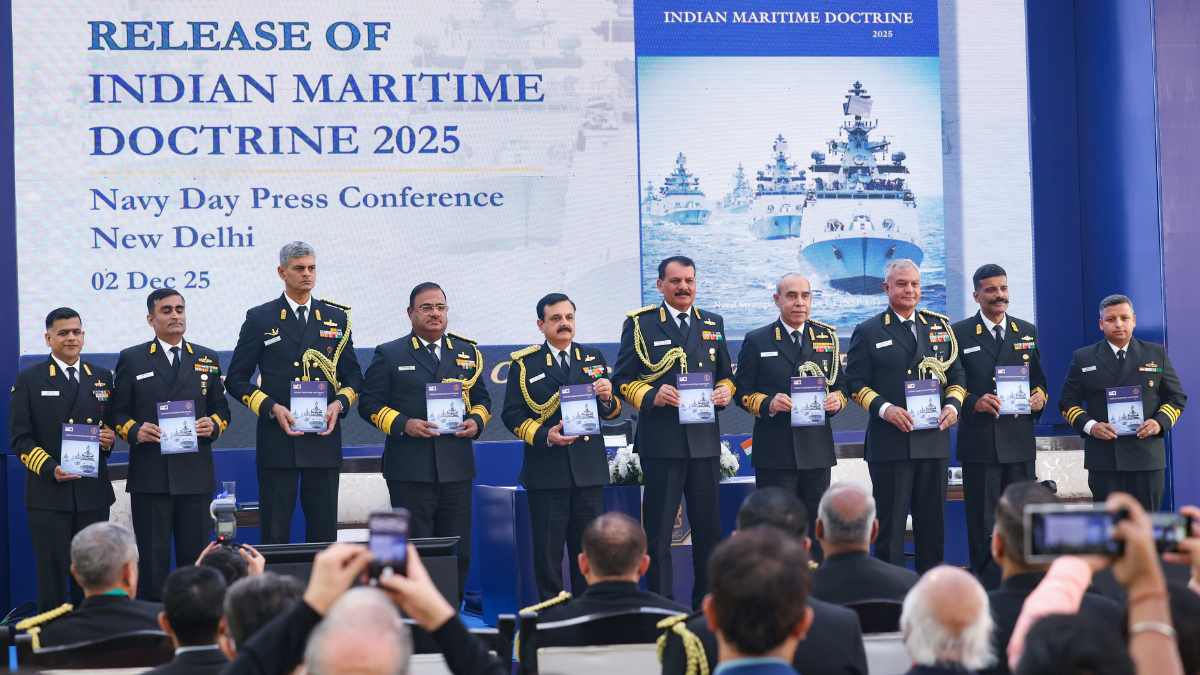

The Indian Navy has secured Acceptance of Necessity (AoN) for 94 capital cases worth approximately Rs 1,27,554 crore since December 2024, alongside contracts for 83 capital cases valued at Rs 84,762 crore under the indigenisation plan, Chief of Naval Staff Admiral Dinesh K Tripathi said on Tuesday (December 2, 2025).
Admiral Tripathi was speaking at his annual press conference in New Delhi ahead of Navy Day celebrations, which will be held in Thiruvananthapuram this year. At the briefing, the Admiral released the Indian Navy’s new Maritime Doctrine and announced that a revised Naval Strategy document will be issued early next year.
The updated Maritime Doctrine, he said, reflects the service’s evolving operational responsibilities and strategic environment, and serves as the apex guidance document for the Navy.
The 2025 edition captures major transformations in India’s maritime environment and strategic outlook. The Indian Maritime Doctrine 2025 lays the foundation for the Navy’s strategy and operations, providing a shared understanding of the principles that guide employment across the spectrum of conflict.
One of the key highlights of the Indian Maritime Doctrine 2025 is that it formalises ‘No-War No-Peace’ as a distinct category between peace and conflict, recognising it as an important facet of the conflict spectrum. It integrates an advanced understanding of tactics employed by adversaries, including grey-zone, hybrid and irregular warfare. The new edition of the doctrine also acknowledges the growing importance of the space, cyber, and cognitive domains.
Operation Sindoor
Speaking on Operation Sindoor, Admiral Tripathi noted that it remains “an operation which is still in progress”, and that detailed operational information could not be placed in the public domain “for obvious reasons”.
However, he stressed that the operation has already demonstrated “our commitment, our readiness, our capability and, most importantly, the deterrence potential of our Navy”.
He said that the Indian Navy’s aggressive posturing and immediate actions, including the deployment of a carrier battle group in the North Arabian Sea, forced the Pakistan Navy to remain in their ports or close to the Makran coast. “The Indian Navy remained ready to do whatever was demanded,” he said.
Adverse impact on Pakistan’s economy
According to Admiral Tripathi, there was also a “noticeable effect on Pakistan’s economy” during the 4–5 days of heightened tension. Many major global shipping companies began avoiding Pakistani ports, he said, adding that insurance premiums rose for ships calling there, reducing the number of merchant vessels willing to take that risk.
“For the last seven to eight months, after those four to five days, we have continued to maintain a high tempo of operations, including in the northern Arabian Sea. We have maintained sustained maritime domain awareness so that we can respond quickly to any eventuality,” he said.
On Operation Sindoor, the Navy Chief said, “Our aggressive posturing and maritime domain awareness ensured that Pakistan Navy never came out. We are maintaining the operational tempo, and we are ensuring that our maritime domain awareness is complete. We exactly know where the Pakistani naval units are deployed.” He added that maritime domain awareness in maritime warfare is the first step.
He added, “As far as the maritime domain awareness is concerned, we are also ensuring that their units do not do anything inimical to our interests, and we are being successful with that.”
Regarding the economic effect on Pakistan during Operation Sindoor, he said that by some estimates, there was a drop of at least 10-15 percent in the trade, which had an economic effect on Pakistan.
Indian Navy’s 2025 operational review
Providing a wider operational overview, Admiral Tripathi said the Navy has logged nearly 11,000 ship-days and 50,000 flying hours since the last Navy Day, with deployments stretching from the Atlantic to the Pacific.
Its anti-piracy mission in the Gulf of Aden, maintained continuously since 2008, has rotated 138 ships and safely escorted more than 376 merchant vessels.
Following the Red Sea crisis of November 2023, the Indian Navy has deployed 40 capital ships to secure merchant traffic, apprehending 62 pirates and ensuring the safe transit of 152 lakh metric tonnes of cargo worth over $6.5 billion.
More than 520 lives have been saved across 30 maritime incidents in the same period, including rescues by INS Teg, which earned commendation from the International Maritime Organisation, Admiral Tripathi said.
He added that the Navy has reported narcotics seizures worth over Rs 43,300 crore over the last year. On force accretion, one submarine and 12 warships have been inducted since the last Navy Day, and 51 platforms are currently under construction.