

Indian Navy To Push For Five ‘Smart’ Destroyers In Answer To China’s Expanding Fleet
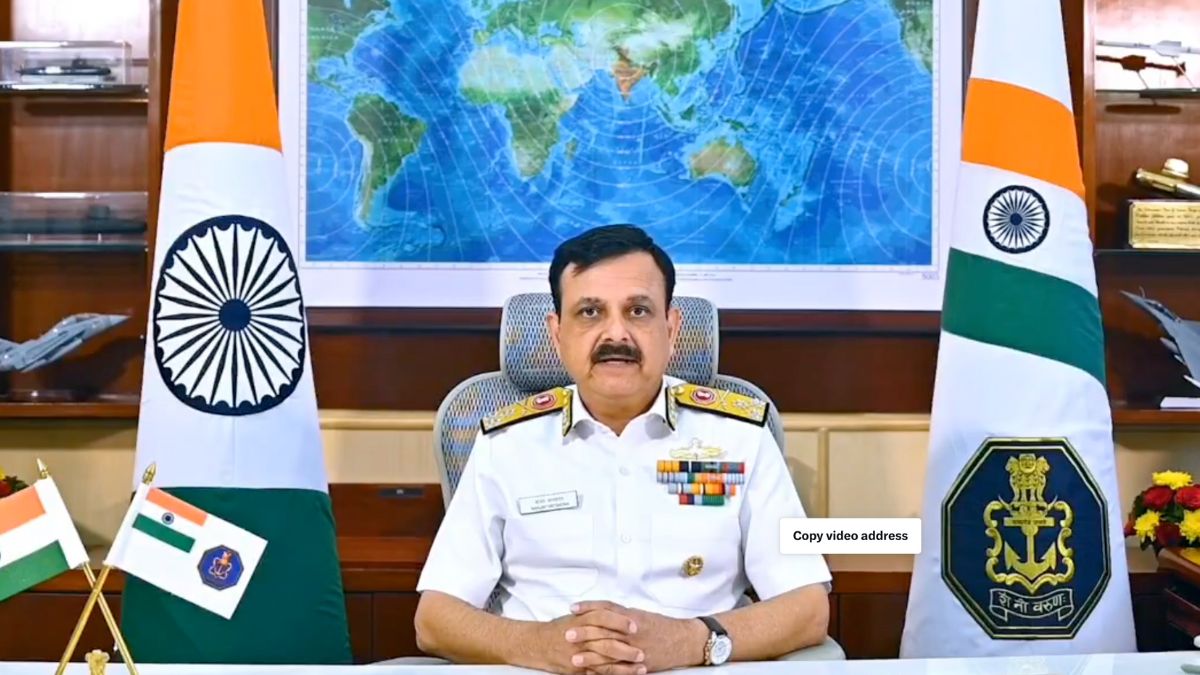
Vice Admiral Vatsayan. Image courtesy: Screengrab from X.com/@Indiannavy

The Indian Navy is preparing to seek government approval for a new line of next-generation guided-missile destroyers — a class of far larger, more heavily armed and technologically advanced warships that service chiefs say will form the backbone of India’s surface fleet in the 2030s.
Vice Admiral Sanjay Vatsayan, the Vice-Chief of the Naval Staff, said on Thursday that the design work was complete and that the service hoped to secure Acceptance of Necessity (AoN) within the current financial year. Contract awards, he added, could follow within two years.
What will the new destroyers bring to India’s naval fleet?
The planned destroyers, expected to displace around 11,000 tonnes, making them the largest in the Navy’s inventory, will be significantly more advanced than both the Kolkata-class and Visakhapatnam-class ships now in service. Naval officials say the platforms are being designed around a suite of “smart ship” technologies tested on a trial vessel over the past year.
While the Navy has not publicly listed the full range of upgrades, reports suggest that the ships will field improved air-defence and anti-ship missile loads, long-range strike capabilities, advanced sensors, greater power generation for directed-energy systems, and deeper integration with autonomous vessels and aircraft.
The timing is stark. China’s naval expansion, from its third aircraft carrier, Fujian, to its new amphibious assault ship functioning as a drone carrier, has accelerated regional anxiety. A recent US Congressional report notes that the People’s Liberation Army Navy (PLAN) fielded more than 370 ships in 2024, a number expected to rise to 395 by 2025 and 435 by 2030.
Beijing is also equipping Pakistan with eight Hangor-class submarines. The first is due for induction in 2026. Asked about the looming arrival of Pakistan’s PNS Hangor, VAdm Vatsayan said India was “monitoring everything closely”, adding that the Navy was already working to strengthen anti-submarine warfare (ASW) architecture to counter such threats.
Why is the Navy making its case now?
The push for approval coincides with the Navy’s annual innovation and indigenisation conference, Swavlamban 2025, where senior officers have been highlighting the service’s rapid shift towards domestic technologies.
VAdm Vatsayan said the Navy has already placed more than Rs 1,400 crore in orders for emerging systems and is preparing further inductions tied to its long-term capability roadmap.
This year’s seminar, themed “Strength and Power through Innovation and Indigenisation”, will showcase technologies developed through iDEX — India’s defence innovation ecosystem — as well as prototypes that have moved from “ideation to induction”. Dedicated exhibit zones will highlight unmanned systems, advanced materials, sensors, electronic warfare suites and propulsion innovations.
The Navy has issued the largest share of iDEX challenges among the armed forces, accounting for 35% since the programme began. Swavlamban 2022, for instance, launched 75 start-up challenges in one go under the SPRINT initiative — more than the cumulative number of defence start-up projects before it.
VAdm Vatsayan said this surge has reshaped the role of small firms. Start-ups and MSMEs, once peripheral, have become “critical solution providers”, gaining unprecedented trust from the Navy and deepening collaboration between industry, academia and the armed forces.
How does indigenous innovation feed into the Navy’s future fleet?
For the destroyer programme, the Navy expects a wide range of domestic technologies to be integrated from the outset, including indigenous sensors, combat-management systems, electronic warfare suites, power and propulsion upgrades, and autonomous-systems architecture. The long view is that India should not merely build warships but embed sovereign technologies into their core.
Swavlamban, naval officers say, helps close the loop: it identifies gaps, scouts solutions from small firms, accelerates trials, and builds prototypes that can be adapted into large-platform designs like the proposed destroyers.
For the government, the decision will have budgetary and strategic implications. For the Navy, the approval would signal that India intends to keep pace with, and counter, a rapidly expanding Chinese fleet.
If cleared this year, the five new destroyers would be among the most consequential additions to India’s surface combatant plans in more than a decade, shaping the force for a maritime region where competition is deepening and firepower is increasingly decisive.