
How Army Is Turning AI Into Battlefield Game-Changer: From Predicting Chinese Movement To AI Summit Showcase
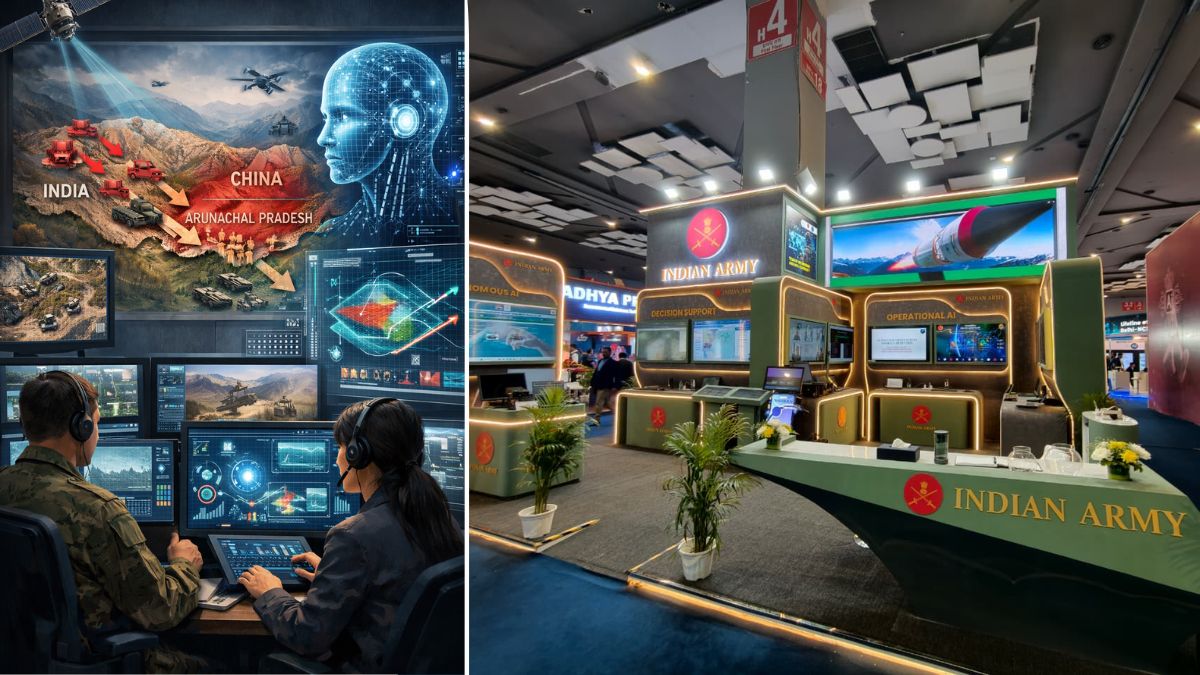
Army’s display at Bharat Mandapam highlighted dualuse platforms designed to serve both defence operations and civilian applications. Image courtesy: RNA

As New Delhi hosts the AI Impact Summit 2026, the first global AI summit in the Global South, India’s armed forces have quietly demonstrated that artificial intelligence is no longer a future ambition. It is already shaping operations on the ground. Indian Army has unveiled a suite of indigenous AI solutions which showcase its ongoing transformation into a datacentric and AI-enabled force.
Not just this, but the artificial intelligence also helped forecasting an “unprecedented” Chinese move along the Line of Actual Control (LAC) in the Northeastern state of Arunachal Pradesh. The Army’s message at Bharat Mandapam is clear: AI is now central to national security strategy.
How AI helped India anticipate a Chinese move along the LAC?
Speaking at the AI Impact Summit, Lt Gen Dinesh Singh Rana, Commander-in-Chief of the Strategic Forces Command, revealed that India successfully used a locally developed AI-powered predictive tool to anticipate and counter a Chinese military build-up in Arunachal Pradesh.
Recounting his tenure as a Corps Commander along the LAC, Lt Gen Rana said the low-cost indigenous system detected early indicators of unusual activity in a disputed sector. “We could see through some AI systems that something was building up. Finally, we were able to predict the timing of their move,” he said.
The Chinese action was described as “unprecedented,” but AI-enabled intelligence allowed timely force positioning, proactive evacuation planning, zero casualties on the Indian side. The episode underscores a major doctrinal shift: predictive analytics and algorithm-driven insights are now embedded in frontline decision-making.
Is AI now central to modern warfare?
Lt Gen Rana was unequivocal in stressing that AI is no longer a “futuristic concept.” He described an ongoing global “AI race,” particularly between the United States and China, with investments surging across military and civilian domains. Major powers are integrating AI into command-and-control structures, autonomous weapons systems, precision strike capabilities, target identification.
In addition, AI is also being embedded into electronic warfare and cyber defence, maritime domain awareness, logistics and predictive maintenance. In cyber operations, AI is being used both offensively and defensively, to exploit vulnerabilities and to protect critical infrastructure.
The Russia-Ukraine conflict, he noted, has demonstrated the effectiveness of scalable, low-cost AI-enabled systems such as autonomous drones, often outperforming expensive, centralised platforms.
Indian Army’s showcase at the AI Impact Summit 2026
At Bharat Mandapam, the Indian Army unveiled a suite of indigenous AI systems, signalling its transition toward a data-centric and AI-enabled force aligned with India’s push for technological self-reliance. The display included dual-use technologies designed for both military and civilian applications, a report in The Hindu outlined.
Key Systems Unveiled:
AI Examiner – An automated assessment and feedback platform aimed at modernising military education and training frameworks.
SAMUN – A geospatial AI-enabled situational awareness system for mission planning, disaster response and integration with smart command centres.
EKAM (AI-as-a-Service) – A secure, air-gapped indigenous AI cloud platform ensuring data sovereignty and secure processing of sensitive information.
PRAKSHEPAN – An AI-driven climatology and disaster prediction system providing early alerts for landslides, floods and avalanches — crucial for both Himalayan deployments and civilian disaster management.
Xface – An AI-powered facial recognition system for identity verification.
Deepfake Detection & AI Cyber Security Systems – Designed to counter synthetic media manipulation, malware and evolving cyber threats targeting critical infrastructure.
Additional systems included:
Nabh Drishti – Mobile telemetry-based real-time reporting and visualisation
Driver Fatigue Detection Device – Real-time drowsiness alerts
AI-in-a-Box – Portable AI solution for remote or disconnected environments
AI-powered Vehicle Tracking System – Fleet monitoring and logistics optimisation
Collectively, the platforms signal the Army’s effort to build a secure, networked and AI-driven ecosystem.
Why is ‘Sovereign AI’ a strategic imperative for India?
At a summit focused on inclusive and responsible AI, Lt Gen Rana also warned of emerging risks, particularly the evolution from narrow AI systems to artificial superintelligence (ASI). Advanced AI, he cautioned, is a dual-use technology. Like nuclear capabilities during the Cold War, it could become a tool of strategic coercion.
However, unlike nuclear technology, AI proliferation is far harder to regulate. With this, he called for a comprehensive national AI security doctrine, alignment of investments with strategic objectives, development of “agentic systems” integrating economic, cyber, space and military inputs, and stronger civil-military fusion and domestic talent development.
“As we aspire to become a superpower, we must also become a responsible AI power, just as we are a responsible nuclear power,” he stated.
What does this mean for India’s military future?
Against the backdrop of the AI Impact Summit 2026, India’s armed forces are signalling that AI is not merely about innovation; it is about deterrence, survivability and strategic foresight. From predictive tools along the LAC to AI-enabled command platforms and disaster systems, the military is integrating artificial intelligence across the operational spectrum.
In the emerging era of algorithmic warfare and digital deterrence, the battlefield advantage may increasingly belong to those who can predict, process and respond faster than their adversaries. And India’s armed forces appear determined to ensure they are not left behind.