


Major Leap In India’s Armoured Vehicle Abilities As DRDO–Ashok Leyland Engine Aces Trials
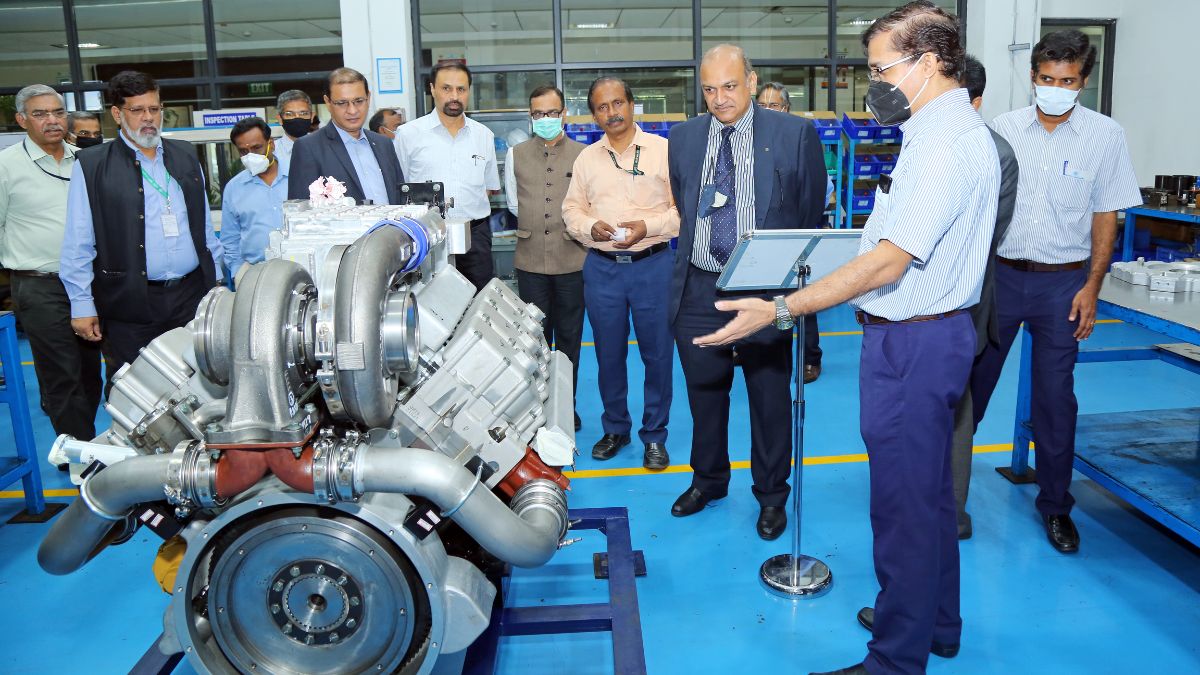
Image courtesy: PIB

India’s push for defence self-reliance received a fresh boost this week after a Defence Research and Development Organisation (DRDO) laboratory announced that a new domestically developed combat-vehicle engine had significantly outperformed expectations during trials.
The 600-horsepower (HP) power pack, created by the Combat Vehicles Research and Development Establishment (CVRDE) in partnership with Ashok Leyland, is now slated to equip the Army’s next generation of wheeled armoured vehicles, according to media reports.
The successful tests mark a milestone for a sector long dependent on foreign engines and vulnerable to supply-chain pressures during crises. For CVRDE and Ashok Leyland, the trial results are being seen as proof that Indian industry can now produce high-performance systems once thought beyond its reach.
How did India’s new combat engine exceed expectations?
CVRDE’s trials, designed to recreate extreme battlefield conditions, revealed that the engine could deliver far more power than its design specification. Rated originally for 600 HP, the unit clocked a peak output of 675 HP at 2,000 rpm — a 12.5% surplus that stunned engineers on the programme.
Officials say the engine demonstrated unusual thermal stability and mechanical resilience, performing reliably under heat, dust, vibration and high-altitude simulation. In military terms, that extra horsepower offers a valuable margin: faster acceleration, improved manoeuvrability and enhanced payload capacity, all without sacrificing long-term durability.
Test engineers noted that the surplus power could play a decisive role in Himalayan deployments, where thin air sharply reduces engine efficiency. The improved output is expected to translate into more agile vehicle handling in zones that traditionally strain military engines.
What is the importance of CVRDE-Ashok Leyland collaboration?
The programme is being held up as a model for India’s public-private partnerships in defence manufacturing. CVRDE brought its experience in armoured-vehicle development, while Ashok Leyland contributed mass-manufacturing capability and automotive engineering expertise.
Researchers emphasise that the cooperation was not merely technical. It involved aligning two very different industrial cultures, a government R&D establishment and a commercial manufacturer, to produce a system that could move seamlessly from the test bench to full-scale production lines.
The partnership, both organisations say, was shaped around reliability in varied Indian terrains, from desert heat to Himalayan cold. The result is a power pack designed specifically for India’s battlefield needs rather than adapted from foreign platforms.
Why does this engine matter for India’s military modernisation?
The immediate beneficiary is the Wheeled Armoured Platform (WhAP), a modular infantry carrier seen as central to the Army’s future mobility plans. With the new engine, the WhAP is expected to gain a stronger power-to-weight ratio, which is a critical factor for high-altitude performance, rapid ingress and withdrawal, and amphibious manoeuvres.
But the engine’s significance extends beyond the WhAP. For decades, India relied on imported German, Russian or American engines for tanks and carriers, leaving supply chains exposed during geopolitical tensions. A domestically produced, high-performance alternative reduces both costs and strategic vulnerability.
Defence planners say the engine could eventually be adapted for artillery tractors, logistics vehicles and even lighter naval systems. With mass production likely to begin after final certifications, the development is being interpreted as a step towards greater autonomy in military powertrain technologies — an area long considered a weak spot.
For the government, the breakthrough fits neatly into the Atmanirbhar Bharat blueprint. For the Army, it promises greater operational flexibility. For the defence industry, it signals that Indian engineering may finally be catching up with the global benchmarks it has long aimed to match.