

India’s Carrier Strike Group Sits Behind A Layered Anti-ASBM Shield Pakistan Cannot Match
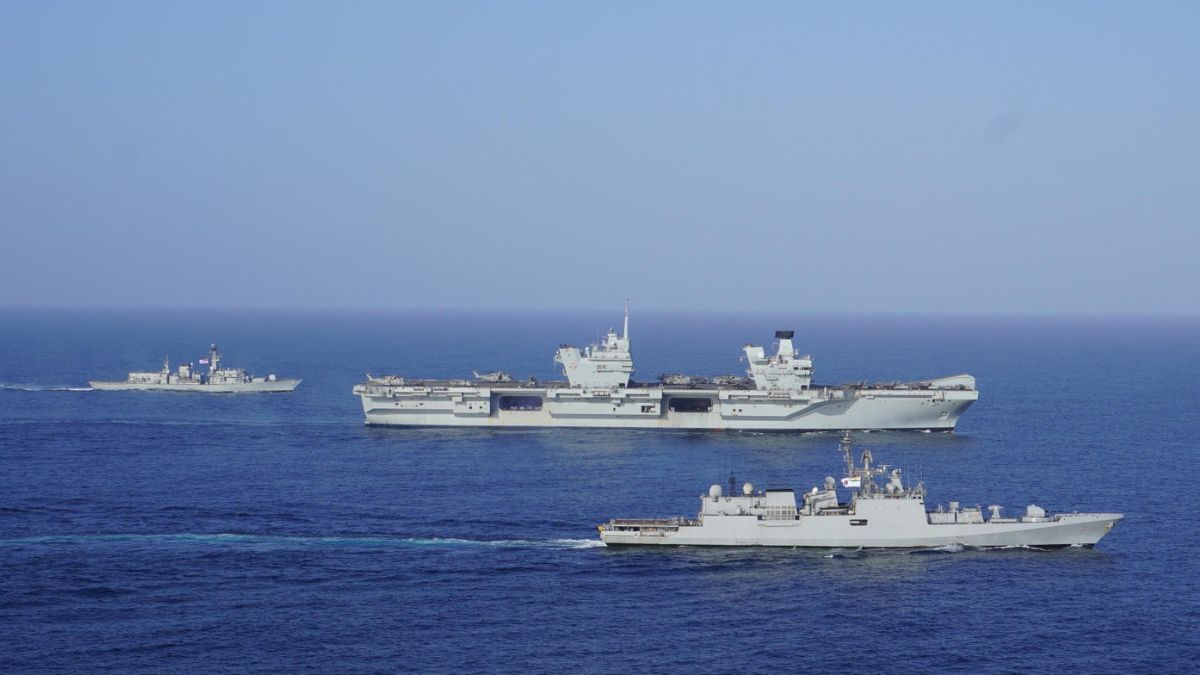
Image courtesy: X.com/@Indiannavy

The Pakistan Navy this month released video and a statement saying it had test-fired an “indigenously developed” ship-launched anti-ship ballistic missile (ASBM). The Inter-Services Public Relations (ISPR) clip and press release have been picked up across mainstream media and amplified on social platforms as proof that Islamabad now possesses a missile that can threaten Indian aircraft carriers.
But multiple technical and operational points do not add up in the public record: Pakistan shows no sustained industrial trail or known programme to field a true ASBM; the frigate used in the clip lacks the vertical-launch architecture a ballistic mission requires; and Islamabad appears to lack the over-the-horizon sensor, satellite and real-time data-fusion chain needed to track and strike a moving carrier at long range.
Even so, if Pakistan somehow possessed a working ASBM, India’s indigenous aircraft carrier INS Vikrant would not be a soft target despite what breathless social-media posts suggest. Here’s why.
Would an ASBM really threaten INS Vikrant?
The short answer: no.
The long answer: No, because INS Vikrant is an operational, indigenous aircraft carrier with built-in self-defences and, crucially, a carrier battle group architecture that places layered protection between a single missile shot and the carrier itself.
The carrier class carries point-and-area defence missiles, close-in weapon systems (CIWS), an electronic-warfare suite, and decoy and torpedo-defence systems.
At the group level, the carrier is escorted by destroyers and frigates equipped with long-range surface-to-air missiles and high-performance radars such as the Multi-Function Surveillance, Tracking And Guidance Radar (MF-STAR), which can detect and engage multiple air and missile targets at extended ranges.
The Indian Navy and DRDO have also been conducting sea-based ballistic-missile-defence trials from a floating testbed, and India is developing longer-range naval interceptors under programmes such as Project Kusha. Together these layers blunt the effectiveness of a stand-alone ASBM.
To be precise:
- Local ship defences. Vikrant-class ships have their own point-defence weapons and short-to-medium range missiles to deal with inbound threats, plus CIWS for last-ditch defence. They also host an electronic-warfare suite and decoy systems designed to confuse radar guided weapons. Those systems complicate a single-shot kill profile.
- Escort and radar umbrella. A carrier at sea rarely operates alone. Core escorts — guided-missile destroyers and frigates — carry Barak-8 (a long-range surface-to-air missile co-developed by the Defence Research and Development Organisation, DRDO, and Israel Aerospace Industries) and are fitted with MF-STAR or equivalent AESA (active electronically scanned array) radars. Those sensors and weapons create a wide, overlapping detection and engagement bubble that can detect, track and attempt to intercept high-speed threats well before they reach the carrier.
- Sea-based BMD and future interceptors. India has tested a sea-based interceptor from the DRDO floating test range INS Anvesh and is progressing Project Kusha — a family of longer-range interceptors intended to give surface ships the capability to engage high-speed ballistic threats at greater ranges. A credible ASBM strike profile against a carrier must account for these ongoing advances.
- Sensor and command architecture. Hitting a manoeuvring carrier at ranges of several hundred kilometres is not just a missile problem but a sensor-link problem. You need over-the-horizon (OTH) radars, persistent maritime reconnaissance (satellite or airborne), datalinks and mid-course update networks to keep a weapon on target. As your technical brief shows, Pakistan currently lacks the comprehensive kill-chain elements that China’s DF-21D/DF-26 concept uses; without that, range and speed of a rocket alone are insufficient. Why Pakistan’s ‘ship-launched A…
How would a carrier battle group respond in practice?
If a carrier-battle group senses a ballistic trajectory or receives warning of a long-range rocket launch, the layered response is sequential: early detection by wide-area sensors; engagement or distraction using long-range surface-to-air interceptors on escorts; electronic attack and decoys to degrade the missile’s terminal seeker; and last-resort CIWS intercepts.
Sea-based BMD interceptors, once matured and fielded fleet-wide, add an additional hard layer that specifically targets ballistic trajectories. Given that ensemble, a single or limited salvo of an unproven ASBM is unlikely to guarantee a carrier kill.