
EAM Jaishankar Pushes ‘Reformed Multilateralism’ As He Hosts Permanent Representatives To The UN Of 7 Countries
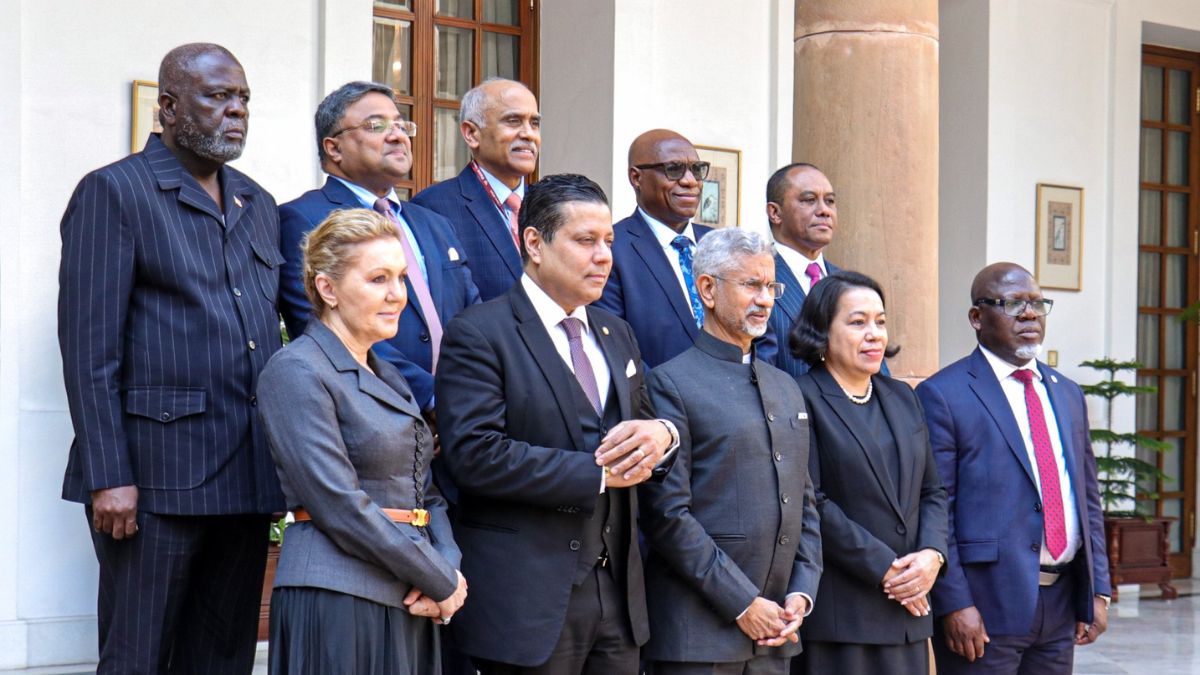
EAM Jaishankar highlighted the broader context of global economic transformation. Image courtesy: X.com/@DrSJaishankar

External Affairs Minister S. Jaishankar has stepped up India’s diplomatic engagement on multiple fronts, hosting a high-level interaction with United Nations ambassadors in New Delhi, meeting Brazilian President Luiz Inácio Lula da Silva, and inaugurating Europe’s first Legal Gateway Office in India.
He did all this while sharpening India’s call for “reformed multilateralism” in a rapidly shifting global order. The series of engagements underscores India’s dual-track approach: strengthening strategic partnerships while advocating structural reform in global governance.
What happened at the UN envoys’ meeting?
Jaishankar hosted the Permanent Representatives to the United Nations from seven countries — the Democratic Republic of Congo (DRC), Greece, Guyana, Liberia, Timor-Leste, Trinidad and Tobago, and Zimbabwe.
In a post on X, the minister described the interaction as a “good discussion on technology and development,” stressing that “reformed multilateralism is more important than ever before.”
The meeting brought together diplomats representing diverse regions, Africa, the Caribbean, Southeast Asia, Europe and Latin America, reflecting India’s broader outreach to the Global South and emerging economies.
Why is ‘reformed multilateralism’ a key theme?
India has consistently argued that global institutions, particularly the United Nations, need structural reform to reflect contemporary geopolitical and economic realities. By emphasising reformed multilateralism during discussions with UN envoys, Jaishankar signalled India’s push for greater representation of developing nations.
He also made a pitch for fairer decision-making mechanisms, stronger cooperation on technology and development, more inclusive global governance frameworks by underlining the importance of reformed multilateralism.
The timing is significant as debates over UN Security Council reform, climate financing, development equity and technology governance continue to intensify.
EAM Jaishankar’s discussion with Brazilian President Lula?
Earlier, Jaishankar met Brazilian President Luiz Inácio Lula da Silva during his State Visit to India, appreciating Lula’s “warm sentiments and guidance” in advancing the India–Brazil Strategic Partnership.
Expressing confidence that Lula’s meetings with Prime Minister Narendra Modi would inject “new momentum” into bilateral ties, Jaishankar’s outreach highlighted growing coordination between two key Global South leaders.
India and Brazil, both influential members of BRICS and the G20, have been aligning more closely on issues such as reform of global financial institutions, South–South cooperation, climate negotiations, multipolar world order.
The meeting reinforced the shared ambition of both nations to play a stronger role in reshaping global governance.
What is the significance of the European legal gateway office?
In another key development, Jaishankar inaugurated the first European Legal Gateway Office in India, describing it as more than just a facilitation mechanism for entry into Europe. “This is not just a facilitation for entry into Europe; it is a bridge between our societies, an expression of trust, and an investment in a shared global workforce,” he said.
Highlighting the broader global transformation underway, Jaishankar pointed to reconfigured supply chains, de-risking strategies among nations, rapid technological disruption, and diverging demographic trends.
The EAM argued that countries able to manage talent flows while ensuring legality, transparency and fairness will be best positioned in the emerging global workforce ecosystem.
Taken together, the engagements reflect India’s expanding diplomatic bandwidth — engaging the UN system, deepening bilateral partnerships, and shaping debates on global labour mobility and technology governance. At a time when geopolitical fragmentation, economic restructuring and digital disruption are redefining global order, India is positioning itself as a champion of institutional reform, and a key architect of multipolar diplomacy.