


Biological Threat Moves Fast, Defies Borders: Jaishankar Flags Need To Modernise Biological Weapons Convention
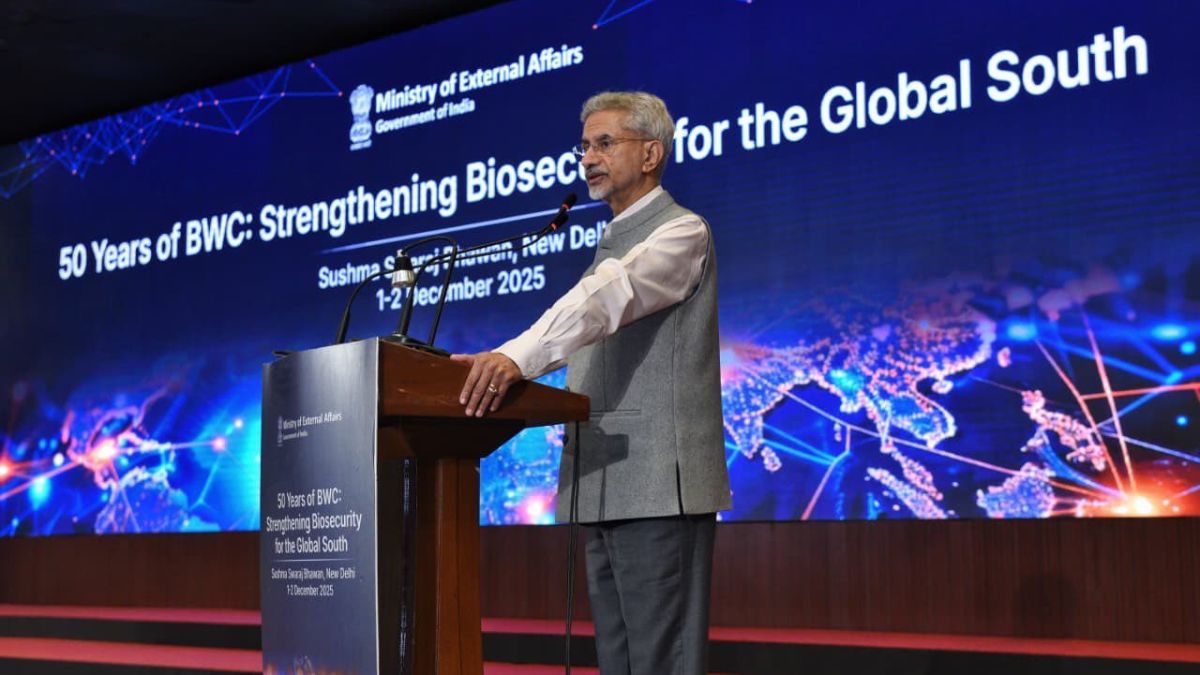
EAM Jaishankar highlighted that they strive to modernise the BWC, the Global South must take ownership. Image courtesy: X.com/@DrSJaishankar

Opened for signature on April 10, 1972 and entered into force on March 26, 1975, the Biological and Toxin Weapons Convention (BTWC), also known as the Biological Weapons Convention (BWC), completed its 50 years, to commemorate which, a conference was held in New Delhi on Monday (December 1, 2025).
External Affairs Minister Dr. S Jaishankar opened the international conference marking 50 Years of the Biological Weapons Convention (BWC) with a sharp focus on the rising relevance of biosecurity in an era of rapidly advancing life sciences. He reiterated India’s commitment to the “full and effective implementation” of the BWC.
Addressing experts and delegates from over 80 Global South nations, the External Affairs Minister positioned the country as a key voice in shaping the future of global biodefence norms. He stressed on the need to ensure that BWC remains the guardrail between innovation and misuse in the life sciences.
Biological Weapons Convetion: What role does the Global South play in strengthening BWC?
EAM Jaishankar underscored that as biological threats evolve quickly and cross borders effortlessly, the world must reinforce safeguards that prevent the misuse of scientific innovation. India, he said, remains committed to responsible stewardship of sensitive and dual-use technologies.

Jaishankar stressed that modernising the BWC requires leadership from the Global South, which he said “has the most to gain from stronger biosecurity and also the most to contribute.” He called on developing nations to “take ownership—preparing wisely for future challenges,” arguing that biosecurity must become a collective strategic priority, not an afterthought.
“Bioterrorism is a serious concern… yet the BWC still lacks basic institutional structures. It has no compliance system, no permanent technical body, and no mechanism to track new scientific developments,” he cautioned.
Worth noting here is that the BWC was the first multilateral treaty categorically banning a class of weapon. The treaty prohibits the development, stockpile, production, or transfer of biological agents and toxins of “types and quantities” that have no justification for protective or peaceful use.
What gaps in the BWC did EAM Jaishankar identify?
In a post on X, he emphasised that the BWC must remain the “guardrail between innovation and misuse in the life sciences” during a time when threats—state-driven, accidental, or non-state—are becoming more complex. Calling the Biological Weapons Convention outdated for modern realities, Jaishankar highlighted its major structural weaknesses:
No compliance verification system
No permanent technical body
No mechanism to track emerging scientific developments
Underscoring this, he urged the global community to work toward stronger compliance mechanisms, enhanced capacity-building, and the creation of institutional structures that make the Convention more effective in an era of rapid biotechnological progress.
“Disease must never be used as a weapon. Biology must serve peace, not advance harm,” he stated. Highlighting the uncertainties in global security and the rapid evolution of biotechnology, Jaishankar noted that the falling cost and rising availability of sophisticated biological tools had introduced unprecedented challenges.
“Whether a biological threat is natural, accidental, or deliberate, it moves fast; it defies borders, and it can overwhelm systems.”
How is India demonstrating global leadership in biosecurity?
Jaishankar pointed to India’s strong record in non-proliferation of dual-use goods, the globally recognised Vaccine Maitri initiative during the COVID-19 pandemic, and the country’s proposals for a National Implementation Framework that covers identification of high-risk biological agents, oversight of dual-use research, domestic reporting and incident management, continuous training and preparedness.
These initiatives, he said, are examples of how India is contributing meaningfully to strengthening global biodefence, safeguarding innovation, and ensuring responsible scientific growth.
Role of international cooperation in biological threat preparedness
In his address, Jaishankar warned that biological threats “move fast, defy borders and overwhelm systems”, making international collaboration essential. He stressed that without deeper global cooperation, no nation, developed or developing, can adequately prepare for the next biological crisis, whether natural, accidental, or deliberate.
Reaffirming India’s long-standing commitment to disarmament and non-proliferation, the Ministry of External Affairs said the conference aims to catalyse a Global South-led agenda for biosecurity and BWC reform. Held at Sushma Swaraj Bhawan on December 1–2, the event brought together scientists, diplomats, and security experts to shape a roadmap for the next 50 years of the Convention.


