
Indian Navy Delivers Bailey Bridges to Sri Lanka, Reconnecting Lives Across the Indian Ocean
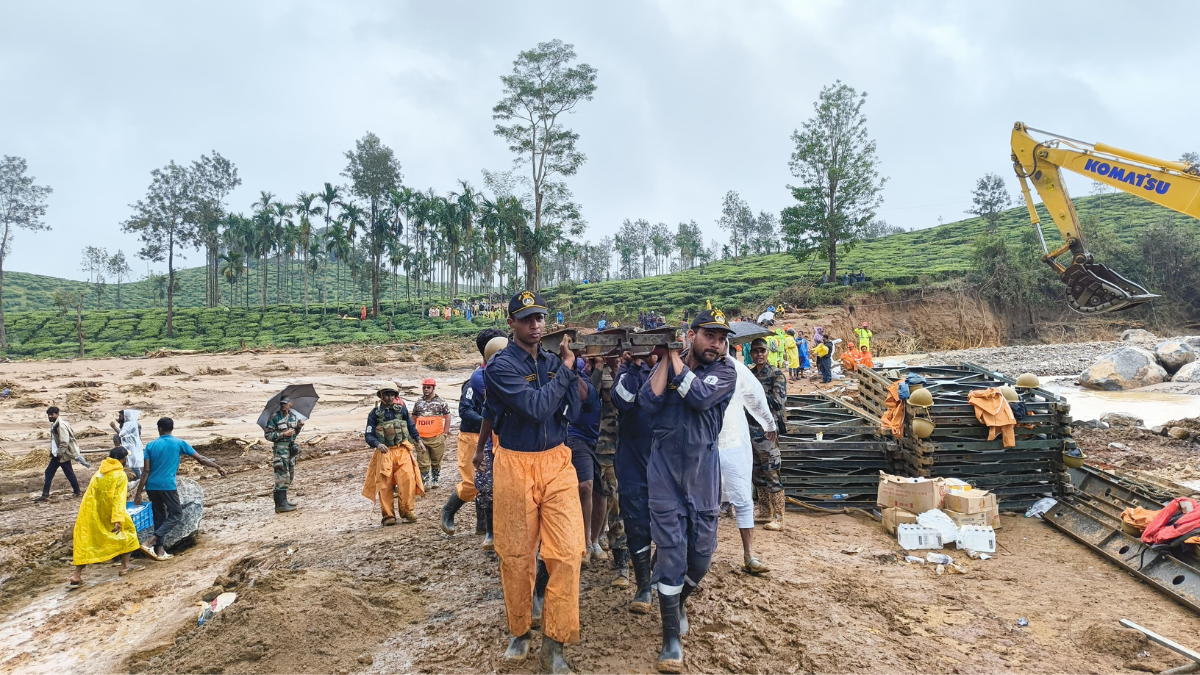
Indian Navy personnel during Sri Lanka floods. Credit: Indian Navy

Sri Lanka celebrates its 78th Independence Day, with flags waving all over Colombo, as families celebrate the day, a grey naval ship silently enters the harbor with something much more meaningful than the celebrations—hope in steel form. On February 4, 2026, the Indian Naval Ship Gharial docked in Colombo with ten Bailey bridges, which are steel structures that will soon link villages and towns severed from the mainland by the Cyclone Ditwah that ravaged the island in late November. For the families left stranded due to roads and crossing points destroyed by the cyclone, the Bailey bridges are more than just infrastructure.
The delivery is part of Operation Sagar Bandhu, India’s large-scale humanitarian mission launched within hours of Cyclone Ditwah striking Sri Lanka on November 27–28, 2025. Torrential rain, flooding and landslides paralysed large parts of the country. In those first crucial hours—when rescue windows narrow and uncertainty grows—India became the first nation to deploy trained disaster-response teams to Sri Lanka. Specialised personnel arrived within 24 hours. So far, more than 450 people have been rescued and assisted.
Relief did not stop with the initial response. Through December, the Indian Navy deployed multiple ships—INS Gharial, LCU 54, LCU 51 and LCU 57—carrying nearly 1,000 tonnes of dry rations and essential humanitarian assistance and disaster relief (HADR) stores to affected regions. Earlier, INS Vikrant, INS Udaygiri and INS Sukanya had provided helicopter-borne search-and-rescue support, reaching areas that were inaccessible by road.
For many Sri Lankans, this response felt familiar. The Indian Navy has repeatedly been among the first to arrive during moments of crisis. In 2004, after the devastating Indian Ocean tsunami, Indian helicopters flew relief sorties to Galle and Trincomalee within hours under Operation Rainbow. Ships such as INS Taragiri, INS Sandhayak and INS Sutlej delivered food, drinking water, tents and medical supplies while assisting with evacuations and debris clearance. During Cyclone Roanu in 2016, INS Sutlej and INS Sunayna were deployed. INS Kirch, an Indian naval ship, delivered relief goods to flood-hit areas in 2017. In 2021, when the container ship X-Press Pearl caught fire off the coast of Colombo, Indian naval forces helped with firefighting and pollution prevention efforts to reduce the impact on the environment.
Over the years, the partnership has also grown to include areas other than disaster relief. In June 2024, Sri Lanka launched the Maritime Rescue Coordination Centre (MRCC), funded by India, to improve the country’s capacity to handle search and rescue activities in its waters. Before this, as a gift on the occasion of Sri Lanka’s 75th Independence Day, India donated a Dornier maritime reconnaissance aircraft to improve surveillance capacity.
In April 2025, during a visit by Indian Prime Minister Narendra Modi to Colombo, India and Sri Lanka signed a Memorandum of Understanding on Defence Cooperation. This is the first agreement of its kind since the Indo-Sri Lanka Accord in 1987.
Recent years have also seen Colombo take steps that acknowledge New Delhi’s security concerns, including a temporary pause on foreign research vessels entering its waters and the introduction of clearer procedures governing military ship and aircraft movement. Strategic cooperation has expanded further through initiatives such as the India–Sri Lanka–UAE agreement to develop Trincomalee as a regional energy hub.
Yet for people in cyclone-hit districts, geopolitics feels distant. What matters now is that broken roads will soon carry traffic again. Children will cross safely to attend school. Farmers will transport produce to markets. Ambulances will reach patients in time.
As those Bailey bridges are assembled across washed-out crossings, they will do what bridges have always done—shorten distances. In this case, they also reinforce something intangible: a relationship across the Palk Strait that has repeatedly shown itself in moments of need.
For India, this approach aligns with its SAGAR vision—Security and Growth for All in the Region. For Sri Lanka, it is experienced in more immediate terms: when disaster strikes, help comes swiftly across the water. And sometimes, friendship is best measured not in statements, but in steel laid across a river when it is needed most.