
Lula da Silva Recalls Lesson He Took From First India Visit In 2005 That Reshaped Brazil’s Economic Strategy
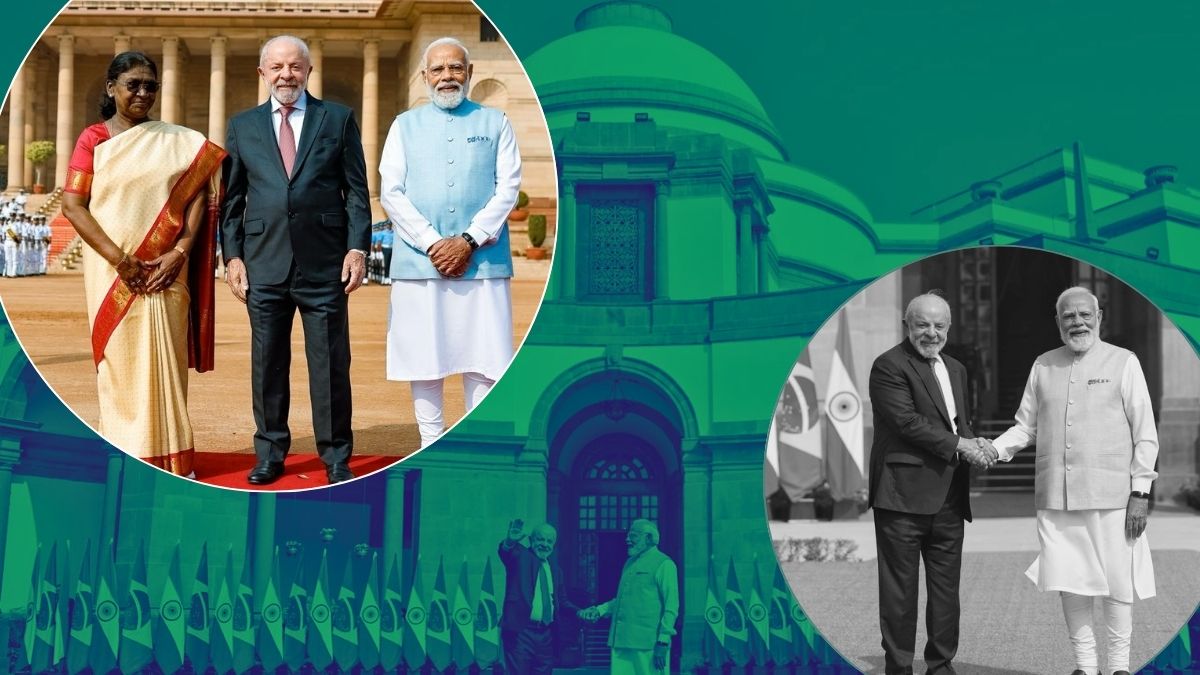
India and Brazil are committed to taking bilateral trade much beyond $20 billion in the next five years. Image courtesy: RNA

Brazilian President Luiz Inácio Lula da Silva’s recent visit to India has added fresh momentum to a rapidly expanding India-Brazil partnership, blending economic strategy, technology cooperation and diplomatic alignment. Both the countries unveiled one of their most ambitious bilateral roadmaps in two decades, announcing sweeping agreements.
Describing the trip as having a “very special characteristic,” Brazilian President Lula not only revisited the transformative impact of his 2005 visit to India but also held substantive discussions with Prime Minister Narendra Modi aimed at elevating bilateral ties across trade, technology and global governance.
The visit, Lula’s fifth as President, comes just seven months after PM Modi’s State Visit to Brasília in July 2025, underscoring the growing frequency and intensity of high-level engagement between the two major Global South powers.
How did a 2005 India visit reshape Brazil’s economic strategy?
Speaking at the India-Brazil Economic Forum in New Delhi on Sunday (February 22, 2026), Lula reflected on how India’s economic management in the early 2000s fundamentally influenced Brazil’s policy direction. “It was in India in 2005 that, for the very first time, I perceived the importance of having international hard currency reserves,” Lula said.
At the time, India had accumulated approximately $100 billion in foreign exchange reserves, a benchmark that Lula said inspired Brazil to build its own financial buffer. “We left that position of debtors of the IMF to the creditors of the IMF,” he noted, adding that Brazil went on to accumulate $360 billion in reserves, then among the largest in the world.
What were the key outcomes of PM Modi-Lula’s meeting?
During his meeting with Prime Minister Modi, the two leaders reviewed progress across strategic sectors and reaffirmed their shared vision for a stronger South–South partnership. Key areas of focus included trade expansion and market access, technology and digital innovation cooperation, artificial intelligence and emerging technologies, Energy collaboration.
Prime Minister Modi announced an ambitious push to take trade beyond $20 billion in the next five years, while both sides reaffirmed a longer-term target of $30 billion by 2030. Another key strategic outcome of their meeting was the signing of an MoU on rare earth elements and critical minerals.
Brazil, which holds significant rare earth reserves, with only about 30% explored so far, sees India as a long-term partner in exploration, processing and industrial development. Lula participated in the India AI Impact Summit during his February 19-20 visit, highlighting the growing role of technology diplomacy in bilateral ties.
Recovering the image of Brazil
Lula framed the visit within Brazil’s broader diplomatic recalibration during his third presidential term. “We decided to recover and retrieve the image of Brazil in the world,” he said, noting that in just over three years, Brazil has opened 520 new markets for its goods.
India, now one of the world’s fastest-growing major economies, is increasingly central to that strategy. For India, closer ties with Brazil enhance its outreach to Latin America and strengthen coordination among major developing economies in global forums.
How is cultural diplomacy strengthening the bond?
Beyond strategic and economic discussions, Lula’s remarks highlighted the softer dimensions of diplomacy. Recalling PM Modi’s 2025 visit to Brazil, Lula said his government had arranged a musical performance tailored to Modi’s preferences as a personal gesture.
In a reciprocal move, Lula was surprised during his current visit when Brazilian songs, including the iconic “Asa Branca,” were played at official events in New Delhi.
With both nations playing prominent roles in BRICS, the G20 and Global South advocacy platforms, the Lula–Modi engagement signals a long-term strategic convergence. The emphasis on AI, economic resilience, diversified markets and institutional reform suggests the partnership is evolving from traditional trade ties into a multi-dimensional strategic alliance.