

How Indian Navy’s ENC Aims To Accelerate Modernisation By Adding INS Taragiri, Anjadip To Fleet
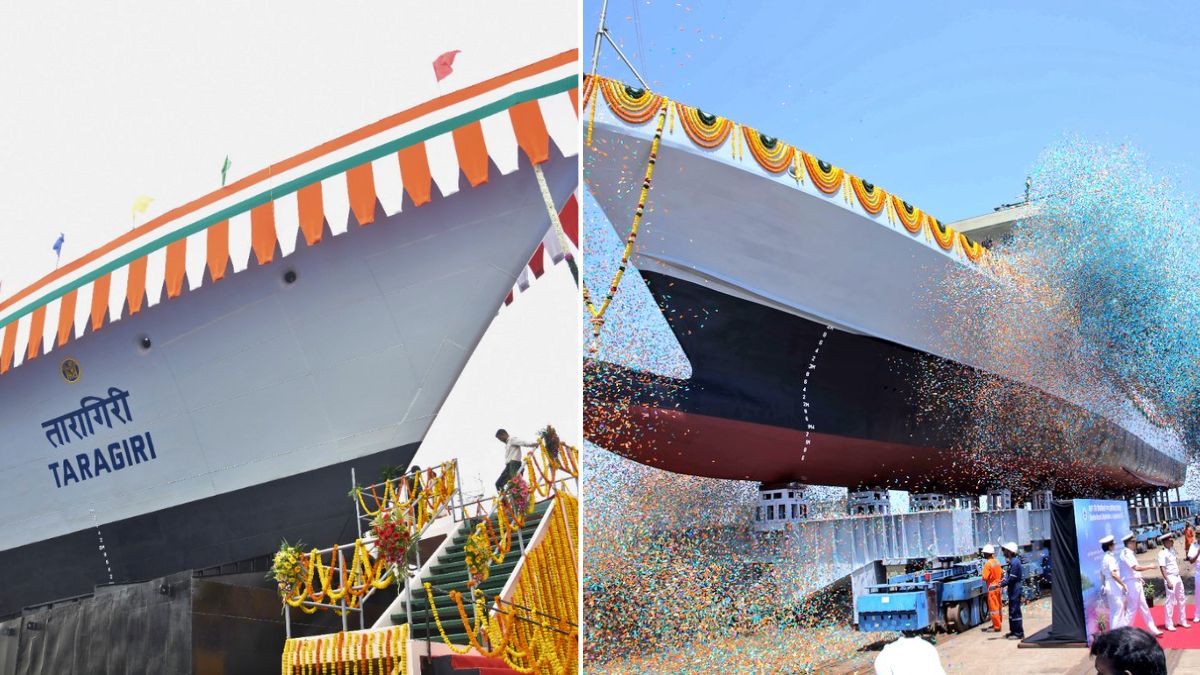

The Eastern Naval Command (ENC) is undergoing one of its most significant capability expansions in recent years, as it prepares to induct two major warships – Taragiri and Anjadip – by January 2026. The upgrade underscores India’s continued push to enhance maritime security across the Eastern Seaboard and the wider Indian Ocean Region (IOR).
Vice Admiral Sanjay Bhalla, Flag Officer Commanding-in-Chief of ENC, confirmed that six new warships have already been commissioned in 2025, with two more slated for induction in January 2026. Of the eight ships inducted into the Indian Navy this year, six have been assigned to the Eastern Naval Command.
Of the eight ships commissioned this year, six have joined the Eastern Naval Command, including Nilgiri-class stealth frigates INS Udaygiri and INS Himgiri, anti-submarine warfare shallow watercraft INS Arnala and INS Androth, and Deep Submergence Rescue Vehicle (DSRV)-supporting units.
ENC fleet: How Taragiri and Anjadip will boost the unit’s naval capabilities
The upcoming ships represent two critical operational domains. While INS Taragiri is a Nilgiri-class stealth guided-missile frigate designed for multi-role operations, long-range surveillance and precision strike, INS Anjadip is an Anti-Submarine Warfare (ASW) Shallow Water Craft tailored for coastal and littoral ASW dominance.
These additions will sharpen both ENC’s offensive surface capability and its defensive submarine-hunting proficiency, areas central to countering regional maritime threats.
INS Taragiri: What makes it a critical addition?
Taragiri is a reincarnation of the erstwhile INS Taragiri, a Leander-class frigate that was part of the Indian Naval fleet from May 16, 1980 to June 27, 2013, rendering 33 years of glorious service to the nation. This state-of-the-art frigate reflects a quantum leap in naval design, stealth, firepower, automation and survivability.
Reflecting a generational leap in indigenous ship design, stealth, survivability, and combat capability, INS Taragiri is fitted with an advanced weapon and sensor suite compared to the P17 (Shivalik) class. These ships are configured with Combined Diesel or Gas (CODOG) propulsion plants, comprising a diesel engine and a gas turbine.
The potent weapon and sensors suite comprises BrahMos SSM, MFSTAR and MRSAM complex, 76mm SRGM, and a combination of 30 mm and 12.7 mm close-in weapon systems, along with rockets and torpedoes for anti-submarine warfare.
INS Anjadip: How this warship would strengthen ENC’s power?
Designed to undertake anti-submarine operations in coastal waters, Low Intensity Maritime Operations (LIMO), and Mine Laying operations including subsurface surveillance in littoral waters, these 77 m long ASW SWC ships have a displacement of 900 tons with a maximum speed of 25 knots and endurance of 1800 NM.
Moreover, INS Anjadip boasts of an over 80% indigenous content, thereby ensuring that large scale defence production is executed by Indian manufacturing units.
Has ENC already boosted Its anti-submarine warfare strength?
Vice Admiral Bhalla recently informed that ASW capacity, notably in the littoral environment, received a major upgrade with the induction of INS Arnala, INS Androth. These shallow-water ASW platforms are equipped with cutting-edge indigenous sensors and weapons, enhancing the Navy’s ability to detect, track and neutralise underwater threats in crowded coastal zones.
The ENC has also seen the induction of three advanced stealth frigates – INS Udaygiri, INS Himgiri, and INS Nilgiri.
These platforms significantly bolster the Navy’s surface combat readiness and expand India’s ability to conduct operations deep into the Indian Ocean. With their stealth profiles, long-range weapons and indigenous warfare suites, these frigates form the backbone of India’s next-generation blue-water fleet.
What role does INS Nistar play in enhancing subsurface ops?
According to Vice Admiral Bhalla, the addition of INS Nistar, a deep-submergence rescue and diving support vessel, marks a rare and elite capability. Very few navies globally possess such advanced underwater rescue platforms. INS Nistar strengthens India’s ability to conduct submarine rescue missions, support deep diving operations, respond rapidly to underwater emergencies.
This places the Indian Navy among a select group capable of executing complex subsurface rescue missions independently.
What role would ENC’s growing fleet have on India’s maritime posture?
According to ENC leadership, the newly inducted ships with advanced indigenous sensors, weapons and surveillance systems have greatly enhanced India’s ability to maintain deterrence, conduct wide-area maritime surveillance, secure the Eastern Seaboard, project naval power across the Indian Ocean Region.
The Eastern Naval Command now maintains a full-spectrum operational profile, surface, subsurface and airborne, allowing India to respond swiftly to crises and protect its expanding maritime interests.
Meanwhile, ENC has over the last year executed a diverse range of missions, including major naval deployments, bilateral and multilateral exercises, coastal security operations, humanitarian assistance and disaster relief (HADR) missions, international cooperation initiatives, search and rescue operations, environmental sustainability projects.
These efforts, Vice Admiral Bhalla said, reflect ENC’s role as a decisive guardian of India’s maritime boundaries and a central pillar of security in the Indian Ocean.